
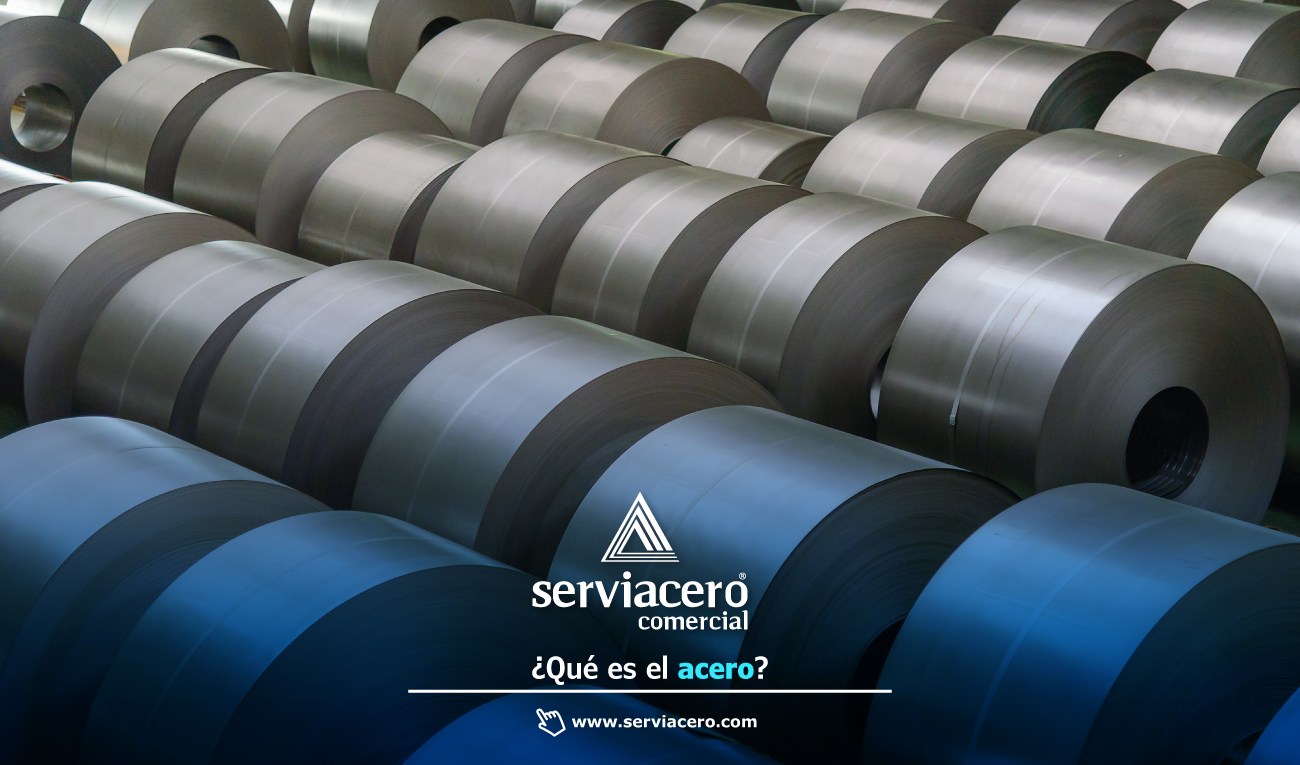
El Acero una aleación de hierro con una cantidad de carbono que puede variar entre 0,03% y 1,075% en peso de su composición, dependiendo del grado.
No es lo mismo que hierro y ambos materiales no deben confundirse. El hierro (Fe) es un metal relativamente duro y tenaz, con temperatura de fusión de 1535 °C y punto de ebullición 2740 °C.
La diferencia principal con el hierro se halla en el porcentaje de carbono: es hierro con un porcentaje de carbono de entre el 0,03% y el 1,075%.
El acero conserva las características metálicas del hierro en estado puro, pero la adición de carbono y de otros elementos tanto metálicos como no metálicos mejora sus propiedades físico-químicas, sobre todo su resistencia.
Existen muchos tipos de según los elementos que estén presentes. Cada tipo permitirá diferentes aplicaciones y usos, lo que lo hace un material versátil y muy difundido en la vida moderna, donde podemos encontrarlo ampliamente sobre avenidas y puentes.
Las propiedades dependen de su composición química y el tipo de tratamiento aplicado. Las características más importantes que todos los aceros comparten son:
Dureza: es difícil de penetrar.
Resistencia: es capaz de resistir torsión, compresión, tracción y flexión sin deformarse.
Maleabilidad: soporta fuerzas sin romperse.
Ductilidad: permite ser deformado a altas temperaturas en forma de hilos y alambres conductores o en láminas delgadas.
Los tipos de tratamiento que son sometidos los aceros para potenciar algunas de sus propiedades son:
Tratamiento térmico: aplicación de calor.
Tratamiento termoquímico: uso de químicos y calor.
Tratamiento superficial: revestimientos de otros materiales.
Tratamiento mecánico: introducción en ambientes fríos y calientes.
Los tipos de aceros se clasifican según su composición. Algunas de ellas son:
Acero ordinario o al carbono: es aquél que se compone solo de hierro y carbono.
Especial: combina hierro, carbono y otros elementos como puede ser aluminio, manganeso entre otros.
Hierro colado: es una aleación que incluye silicio o níquel usado en tubos y válvulas, bombas y repuestos automotrices gracias a su resistencia a la corrosión de líquidos con pH alto (neutros y alcalinos). Se clasifica, a su vez, en hierro fundido gris y hierro fundido nodular.
Inoxidable: la composición de este incluye cromo que lo hace resistente a la corrosión y a la oxidación. Además, tiene una apariencia más atractiva ya que es pulida.
Acero rápido: este tipo de aleación contiene tungsteno usado para fabricar herramientas de corte de gran velocidad usada en fábricas.
Los dos componentes principales del acero se encuentran en abundancia en la naturaleza. Se puede reciclar indefinidamente sin perder sus atributos, lo que favorece su producción a gran escala.
Esta variedad y disponibilidad lo hace apto para numerosos usos como la construcción de maquinaria, herramientas, edificios, estructuras eléctricas y obras públicas, en la aeronáutica, en la industria automotriz, en invernaderos, en instrumental médico, en el sector mueblero entre otros. Contribuyendo al desarrollo tecnológico de las sociedades industrializadas, pues ningún material logra igualarlo cuando se trata de resistencia al impacto o la fatiga.
Conoce todos nuestros productos, dentro del sitio web de Serviacero Comercial.
Conoce nuestro LinkedIn para estar más informado en temas similares.